
Rebecca Olds is a freelance dress historian offering
research, teaching, making and interpretation services
to museums, heritage sites, private collectors,
living historians and re-enactment groups.
This website is currently under review as we transition the legal and regulatory framework from the UK to the EU.
Bookings for 18th century gown-making workshops in 2027 will open shortly,
and Rebecca is taking enquiries for lectures and research consultancy work.Please note that Rebecca’s order book for bespoke gown commissions is currently full but she expects to re-open her order book in May 2027.
Scroll down to sign up to the Timesmith newsletter for news and updates and do not hesitate to contact Rebecca directly in the meantime with your enquiries.

Photo credit: Simon Lees 2019. Edited by Lauren Stowell.
Rebecca specialises in the cut and construction of women's clothing during the “long 18th century” — the golden age of the mantua-maker! She researches how clothing of this period was made and, in doing so, delves deep to understand how mantua-makers were trained, the skillsets they developed, and their experiences as makers and businesswomen.
While it was economic, social, political and cultural changes in France and England that first gave rise to the development of the mantua and the mantua-making trade, Rebecca is particularly interested in how mantua-makers in Scotland and the Low Countries (now the Netherlands and Belgium) both adopted new styles and adapted cutting and construction techniques to serve the practical requirements and fashionable tastes of the women they clothed.


Learning through reconstruction: using a test gown to demonstrate cutting and order of construction employed in the making of the Isabella MacTavish Fraser gown.
Rebecca welcomes consultancy work from museums, heritage sites and owners of private collections of historical dress who seek to better display, understand or document objects of historical dress in their collections. She can work with your team to produce full written descriptions of style, cut and construction and, where needed, make accessories or underpinnings to better display original garments. and can assist curators with writing interpretative panels within exhibitions.
She is a seasoned interpretor of 18th century clothing and the mantua-making trade, delivering on-site events featuring public demonstrations of dressmaking techniques and practices. She is skilled at engaging with visitors while making a complete 18th century gown, whether working solo or leading a team of stitchers. Every event is tailored to the requirements of the venue, be it in conjunction with a current exhibition — as she has done in Edinburgh for National Museums Scotland’s “Wild and Majestic: Romantic Visions of Scotland” (2019) and the National Trust for Scotland’s “Ramsay and Edinburgh Fashion” (2024) — or to enhance interpretation of people and events — as for Paxton House’s “Parallel Lives” project in the Scottish Borders (2023).
Rebecca particularly enjoys making reconstructions of historical dress that serve to illustrate the original form of garments that may have experienced significant alteration or deterioriation in the centuries since they were made. Providing a replica that can be examined and handled by the public, when the original cannot, helps make precious, fragile objects (and the skills involved in making them) accessible to new audiences.
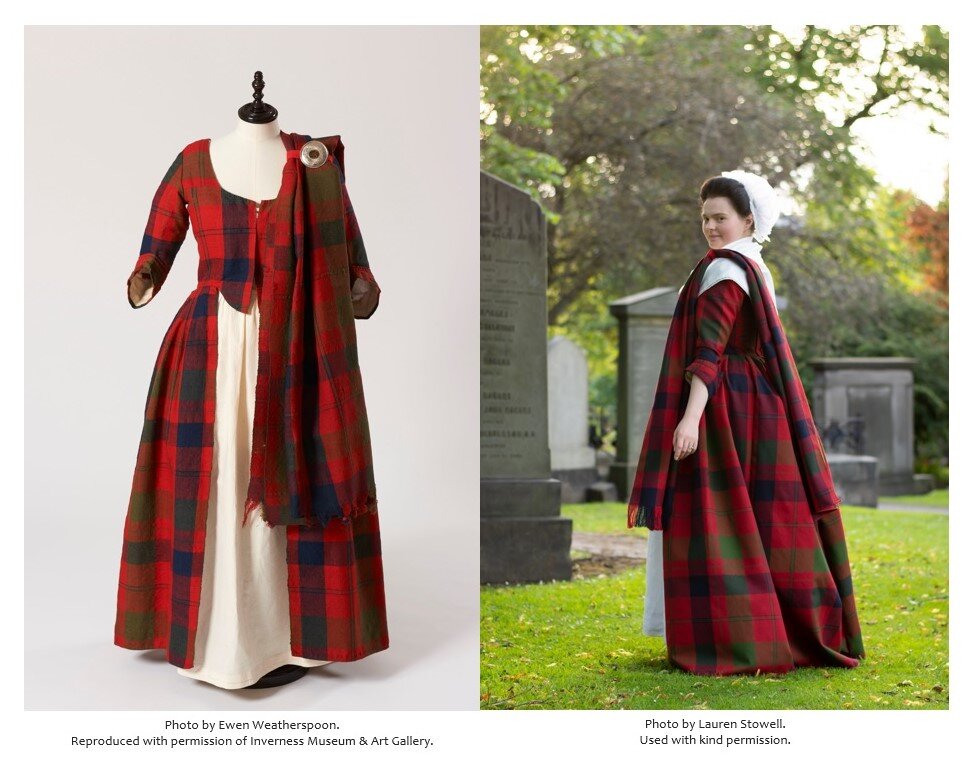
Left: 1785 wedding dress of Isabella MacTavish Fraser in the Inverness Museum & Art Gallery, the only known surviving gown made of “hard tartan” pre-dating 1800.
Right: the re-creation of this gown made by a team of historical dressmakers led by Rebecca Olds in June 2019 as a live mantua-making demonstration in the National Museums Scotland, part of the public programming for the museum’s major exhibition “Wild and Majestic: Romantic Visions of Scotland”. The photo at the top of this page was taken at the beginning of that event.
Rebecca offers hands-on workshops and classes so that you, too, can learn the ways of the mantua-maker. Click Guest Speaking & Teaching to invite her to speak at your event or to teach your group. Or if you cannot organise such an event yourself, keep an eye on the Workshops page to find out about ticketed events where she will be speaking or teaching.
Meanwhile, Rebecca’s hands-on ‘experimental history’ approach to her research produces a steady stream of hand-made items made using "original practice” techniques — 100% hand stitched with period appropriate textiles. Such items include unfitted garments and millinery, already made up individually in just one size. Feel free to Contact Us to enquire what items are currently available. In some cases, you can order something similar to items we may currently have, to better fit you and suit your tastes.

Photo credit: Barbara Olds 2020.
Rebecca also runs a limited Order Book for personal commissions, making completely bespoke fitted garments, such as stays and gowns, suitable for living history, reenactment and high-quality social costuming.
If you would like a custom garment and are willing to do the stitching yourself, Rebecca offers custom pattern drafting services for Stays and Gown Bodice Shapes.

The mantua-maker’s art: cutting shapes on the body. Photo credit: Mike Redgate 2021.