The Isabella Project:
Re-creating Isabella Mactavish Fraser’s iconic tartan wedding gown
On 12 January 1785, Isabella MacTavish married Malcolm Fraser on the Ruthven estate near the small town of Dores on the eastern shores of Loch Ness in the Scottish Highlands. For their wedding, she wore a vibrant tartan gown in the style called the English Gown or Nightgown or Robe a l’Anglaise. Isabella’s wedding gown survives to this day, worn by a succession of brides and still owned by Isabella and Malcolm’s direct descendants. It is the only known pre-1800 extant example of a woman’s tartan gown.

Photo: Rebecca Olds 2019

Photo: Rebecca Olds 2020
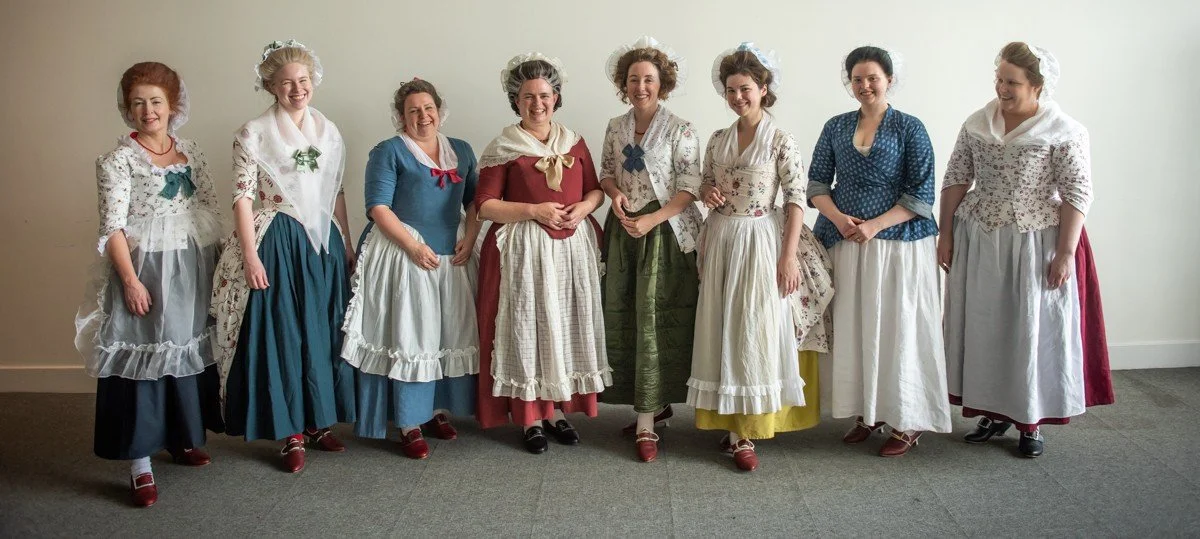
In June 2019 following a year of research, Rebecca headed up a team of historical dressmakers (including Lauren Stowell, Abby Cox, Peryn Westerhof-Nyman and Katy Stockwell) to stage a re-creation of this iconic gown as a live public event at the National Museum of Scotland over the weekend of 29-30 June 2019.
The event was titled “Wedding Gown In A Weekend” and was part of the public programming in conjunction with the Museum’s major exhibition “Wild and Majestic: Romantic Visions of Scotland”, in which the original gown was prominently displayed in the opening gallery.
The process of re-creating Isabella MacTavish Fraser’s gown clarified ambiguities about its cut and construction that had not been easily resolved by other researchers through examination alone. Attempting to replicate, in particular, the order of construction revealed obstacles encountered at several fitting stages. It was only in facing these fitting challenges in actual practice that the solutions were understood, revealing efficiencies and specific construction techniques that shed light on the skills and expertise of mantua-makers in the Scottish Highlands during this period. Comparing these methods to those employed in other gowns of the period also offers insights into the working life of rural mantua-makers, their knowledge of current fashions and the kinds of work they were commonly commissioned to do.
The collaboration that clearly took place between maker and wearer during the construction of the original gown challenges common views about the ‘backward’ ways in the rural Highlands, especially of the non-elite, and rebuts the devaluation of “women’s work” that has occurred since the death of the female-dominated trade of mantua-making.
Lessons from Isabella MacTavish Fraser’s gown can only be meaningful when examined through a multi-disciplinary lens, taking into account her socio-economic situation in the central Highlands of Scotland in the last quarter of the 18th century insofar as this impacted her access to modern goods, services and expertise and her interactions with the burgeoning consumerism in Scotland during this time. Meanwhile, sourcing reproduction fabric to match the original textile prompted consideration of tartan’s cultural significance and uses in Highland communities forty years after the failure of the final Jacobite Rising.

Photo by Simon Lees, edited by Lauren Stowell.
Rebecca continues to research mantua-making as a thriving female-dominated trade in Scotland, including in rural communities throughout the Highlands, with a special interest in the training and skillsets required and how women ran their businesses and made their living doing this work.
By using our re-created dress as an educational tool, Rebecca’s aim is to initiate discussions about how women's garments like Isabella’s were made in the 18th century, not only with those who already have a particular interest in the period or in fashion history, but with the general public. Conversations that go beyond "what did grandma wear?" to "where'd she get it? could she make that herself? if not, who did make it? and how?" This project is not a careful study of a garment in an isolated backroom in a museum but serves to engage with our own cultural heritage and personal histories as interpretative experiences.
Our research findings are being shared in a number of ways. To date, Rebecca and her project partners have produced:
a 25-minute mini-documentary covering the live event and the wider contexts of the dress's history and the overall project — on the American Duchess YouTube channel
an online lecture delving further into the historical contexts (18th century fashion history, Scottish history, tartan history, economic and social history as relating to women’s clothing) — on the Timesmith Dress History YouTube channel
a digitlal 28-page booklet detailing the cut and construction of the original gown by reference to a pattern taken from one of our test dresses — drafted and published free of charge on the American Duchess website
a video demonstrating the detailed making of a gown following the instructions in the American Duchess pattern — on the Timesmith Dress History YouTube channel
online community outreach - the “Isabella Dress Club” Instagram account (curated by Timesmith Dress History) highlighting key construction details of the original gown and showcasing interpretations created by modern sewists using American Duchess’s digital pattern book.

Photo: Lauren Stowell 2019.

Photo: Lauren Stowell 2019.
CREDITS