
In-Person Workshop:
MANTUA GOWN (circa 1705-1715)
Bannockburn House, Stirling, Scotland (UK)
23-26 March 2027
A note on skirt supports and petticoats:
The period correct support is a hooped petticoat with a modest bell shape, such as those depicted in the 1719 etching below of a Paris market stall. These petticoats were invented in England in 1709 and quickly became the standard for the fashionable silhouette of a mantua gown.
However, not all women wore these new-fangled petticoats, so if you do not wish to make/source or wear one, by all means feel free to make your gown without any skirt support, so that it falls in a natural shape suitable for everyday wear.

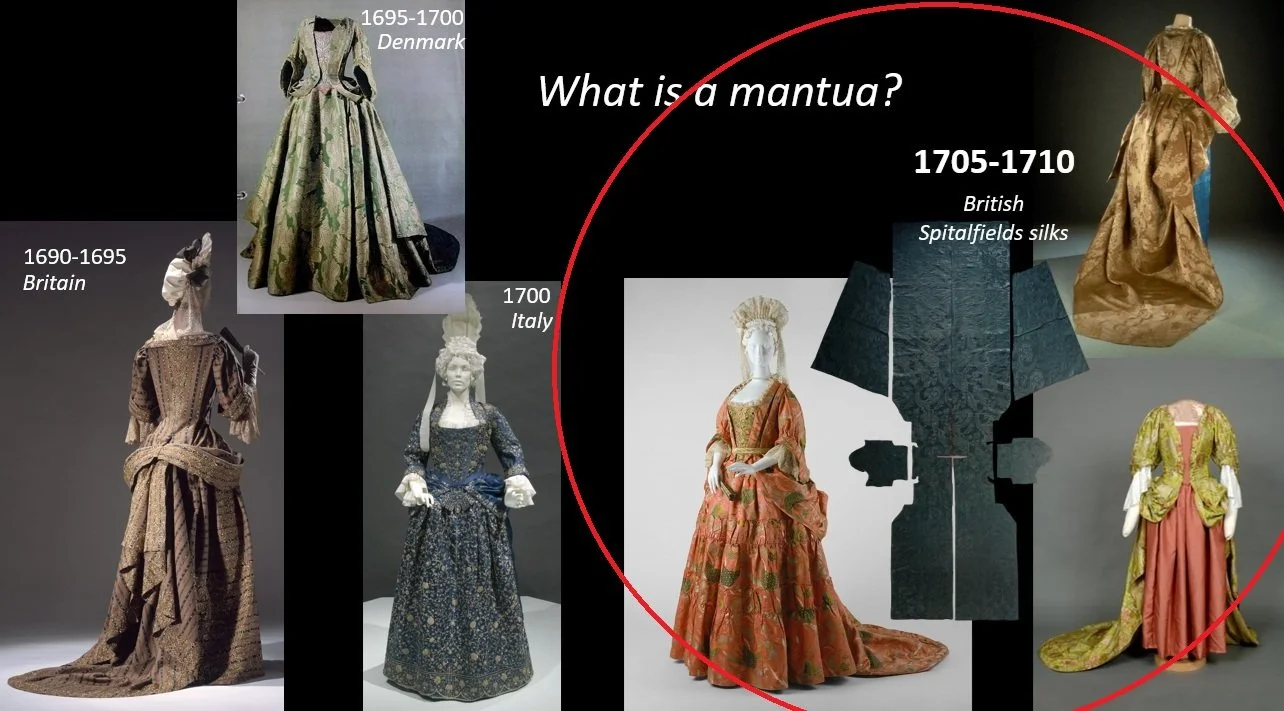
Petticoats worn with mantua gowns in the period we are interested in (c.1705-1715) generally were of the same fabric as the gown. If you do opt to wear a hooped petticoat support, then the fashionable petticoat worn over it would generally involve both pleating and gathering several meters of fabric to yoke, at about hip level, creating a tiered look. Such a petticoat survives with the salmon-coloured mantua in the centre of the image above, and there is a sketch of a similar petticoat on page 40 of Patterns of Fashion 6. Please contact me if you are interested in making such a petticoat - I was involved with making one at The School of Historical Dress in 2023 and while I don’t have a pattern or detailed notes, I can give you some pointers.
Venue environment
This workshop is being held in the formal dining room of a 19th century extension at the back of a 17th century house in Scotland. This space is on the ground floor.
The house is the site of active conservation, preservation and remedial works.
There is no central heating installed. Site staff will install free-standing electric heaters throughout the workshop space, but the room is large and high-ceilinged so participants should be prepared to mitigate cold temperatures (in which is technically still winter!) through their clothing. No guarantees can be given that air temperature within the venue will meet the UK legal winter minimum of 16 degrees Celsius.
The floor of the house is not entirely step-through throughout; several doorway thresholds involve 1-2 steps. There are lifts in the building.
A modern toilet block is located in the ex-stable yard adjacent to the house. Access to it from the workshop space involves negotiating steps.
Likewise, access to the workshop space itself involves negotiating steps, with the most direct route from the house’s main entrance going via a half-flight of stairs. Longer alternative routes are available but they are not 100% step-free.
Prospective participants are encouraged to discuss any concerns they may have about the environment and/or access, during pre-booking dialogues with Rebecca, so that every effort can be made to make reasonable accommodations to enable safe participation.
Workshop conditions
Each participant will be provided with a table (approx 160×75) and a folding chair.
Some work, such as fittings, may require periods of standing. Participants should be prepared for durations of standing from 15-45 minutes at a time, 1 or 2 times each day, most if not all every day of the workshop, with the possibility that the final day may involve more.
The floor is uncarpeted.
The workshop space has tall windows on one side (facing southeast) and at one end (facing southwest). Natural lighting will vary depending on time of day and weather outside. Note that workshop dates fall within British Standard Time before the clocks advance for summer.
Food & Drink
I have arranged for the venue to provide teas and coffee and a trayback with a selection of biscuits and cakes.
Participants will need to bring their own lunches. A fridge and a microwave will be available for your use.
This in-person workshop teaches how to make your own early 18th century MANTUA GOWN (or “Manto” as we see it in period Scottish texts) — the style from which many later gowns evolved — entirely hand-stitched, using cutting, fitting and construction techniques as seen in the handful of mantuas that survive from this era.
This style was flat-cut from strategically folded fabric and then draped to fit. You will learn how to create the shaped pleat structures on both front and back of the gown. You should be able to complete this workshop with a good understanding of the cut, construction and order of operations for this style gown.
This workshop is suitable for those new to 18th century gownmaking. Students who have previous experience with pleating various styles of 18th century gowns in period configurations will benefit from this opportunity to extend their knowledge to an earlier style, supported by my instruction.
Unlike the other two gown styles being taught in Scotland this spring, fashionable mantuas of the early 18th century were generally not constructed with a bodice lining — and you’ll gain insights into why this was! Nonetheless, having well-fitted linings ready to hand can be helpful when fitting this style. It is up to you whether you decide to bring bodice lining patterns or shapes to this workshop.
Please note, classes will formally start on Tuesday 23 March 2027. Optional activities (not included in the workshop price) will be available the previous day, Monday 22 March 2027, such as:
From 10.00-12.30, a group will visit the National Museums Scotland’s costume storage facility in Granton (Edinburgh). Acting Curator of Historic Fashion & Textiles Emily Taylor will facilitate our viewing of 4-5 gowns from across the 18th century. Cost per person will depend on how many of us participate, estimated £37.50-£50.00. We will need a minimum of 6, for this visit to go ahead.
an afternoon tour of our 17th century venue, Bannockburn House, with its rich history as the home of the Patersons, a Jacobite family at the very heart of the 1708 and 1715 Risings — contexts that inspired our choice of gown style to teach in this setting! Prince Charles Edward Stewart stayed here twice during the 1745-46 rising, surviving an assassination attempt in his bedroom. The House was later home to Wilsons of Bannockburn, the renowned tartan design and weaving family. More recently, it has been a filming location for Outlander: Blood of my Blood and the BBC’s Lucy Worsley Investigates: The American Revolution. Ticket price £5 per person.
independent excursions to nearby sites of interest, such as Stirling Castle (traditional home of Scotland’s Stuart monarchs including Mary Queen of Scots), Castle Doune (filming location featured in STARZ’s Outlander, Game of Thrones and Monty Python and the Holy Grail), the Wallace Monument, amongst others.
limited appointment slots for personal “Cutting Shapes to the Figure” service with Rebecca, if you include this in your workshop booking request. (A few slots for this may be available on Sunday, 21 March 2027, as well.)
PLEASE REFER BACK TO THE MAIN GOWN WORKSHOP PAGE
FOR DIRECTIONS ON HOW TO BOOK THIS WORKSHOP.